
 Tiếng Việt

How to Choose the Right Jewelry Making Machine for Your Business
Choosing the right jewelry making machine can make or break your factory's productivity. While beginners focus on brand names and price tags, experienced factory managers know that the real question is: does this machine fit my specific production line?
This guide is written for established jewelry manufacturers who are upgrading equipment, expanding capacity, or adding new product lines. If you already have basic production capability and want to scale efficiently, these insights will help you make the right investment.
Questions Every Factory Manager Should Ask Before Buying
Before looking at any machine specifications, answer these five questions honestly. They will determine which machine category is right for your factory.
What is your current production volume per shift? — A machine designed for 5 kg/day will struggle at 20 kg/day. Know your baseline.
What wire diameters do you process most frequently? — If 80% of your orders are 0.8mm wire, you need a machine optimized for thin wire, not one that compromises precision for range.
Do you need multi-size flexibility or dedicated single-size production? — Job shops benefit from flexible machines. Dedicated production lines benefit from fixed-configuration machines with higher throughput.
How many operators can you allocate per machine? — Fully automatic machines cost more upfront but reduce labor requirements by 60-80%.
What is your acceptable payback period? — Most factory owners expect ROI within 6-12 months. If the machine takes longer, it may not be the right fit.
Factory-Level Decision Matrix
Not all jewelry factories have the same requirements. Use this matrix to determine which automation level fits your operation:
| Factor | Small Workshop | Medium Factory | Large Factory |
|---|---|---|---|
| Daily output needed | 5-10 kg | 20-50 kg | 80-200 kg |
| Automation level | Semi-auto | Fully auto | CNC + IoT |
| Operators per machine | 1 | 0.5 (one runs two) | 0.25 (one runs four) |
| Budget range | $3K-$8K | $10K-$25K | $30K+ |
| ROI expectation | 6-12 months | 12-18 months | 18-24 months |
A medium factory with daily output of 30 kg will benefit most from a fully automatic diamond cutting machine. Attempting to use semi-automatic equipment at this scale would require 3-4 extra operators per shift, wiping out the cost savings.
Supplier Evaluation Checklist for Bulk Buyers
When your factory is making a significant equipment investment, a simple brochure review is not enough. Use this checklist when evaluating jewelry machinery suppliers:
| Criteria | Why It Matters |
|---|---|
| Minimum order quantity | Some suppliers require 5+ units for factory pricing. Confirm before negotiating. |
| Lead time for custom molds | 10-15 days is standard. If urgency matters, ask about rush options. |
| Certification | CE certification is the international minimum. ISO 9001 indicates quality management. |
| Spare parts availability | Can you get a replacement diamond tool or motor within 48 hours? Ask about their parts warehouse. |
| On-site installation and training | For factories buying multiple units, on-site service should be included in the contract. |
| Remote support response time | WhatsApp/WeChat response within 2 business hours is the industry standard for Chinese suppliers. |
| Warranty period and coverage | 12 months parts and labor is standard. Read the fine print on what is excluded. |
| Third-party inspection accepted | Can you send SGS or TÜV to inspect before shipment? Reputable suppliers welcome this. |
→ If you are just starting out, our [Beginner's Guide]
→ See how real factories [achieved ROI] with the right equipment choices."
Scaling Production: From Single Machine to Production Line
Growing a jewelry factory is a gradual process. Here is the typical capacity scaling roadmap used by successful manufacturers:
Phase 1: Core Machine + Manual Feeding
Start with a single automatic diamond cutting machine or bead making machine. One operator handles feeding, monitoring, and collection. Daily output: 10-15 kg.
Phase 2: Add Automatic Feeding and Collection
Install feeding systems and a coiling mechanism. Now one operator can run the machine and focus on quality inspection. Daily output: 20-30 kg. Labor per kg reduced by 40%.
Phase 3: Second Machine for Parallel Production
Add a second machine running a different wire size or pattern. One operator can now manage both machines with automatic feeding. Daily output: 40-60 kg. Labor per kg reduced by another 30%.
Phase 4: Full Production Line with Integration
Connect multiple machines with conveyor systems and centralized control. One supervisor manages 3-4 machines plus quality control. Daily output: 80-120 kg. Labor cost per kg drops to 20% of the Phase 1 level.
Machine Configuration for Common Production Scenarios
Here is how real factories configure their equipment for specific product lines:
Gold Chain Production
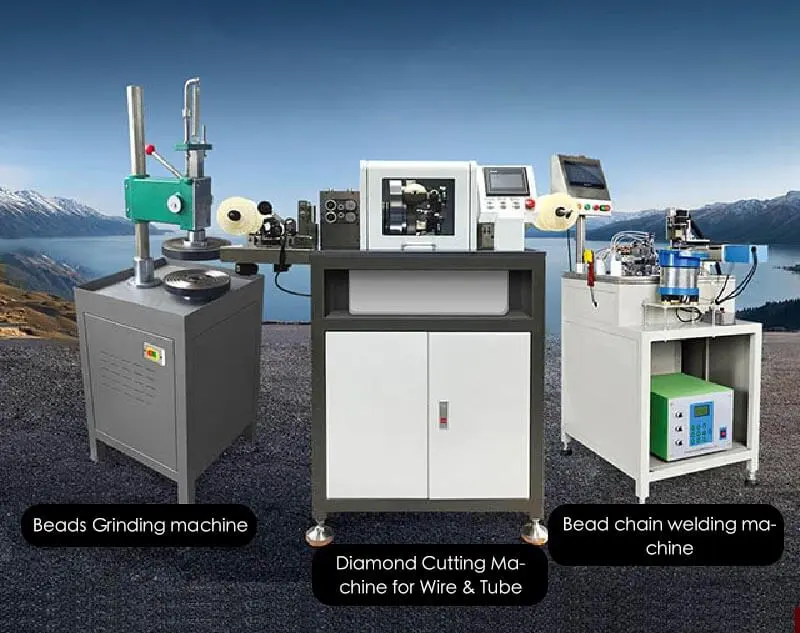
Diamond cutting machine (wire up to 2.0mm)
Wire forming machine
Chain welding machine
Wire diameter range: 0.4mm to 1.5mm
Gold Bead and Hollow Bead Production
Bead making machine (semi or fully automatic)
Diamond cutting machine for surface finishing
Polishing barrel or tumbler
Mold diameter range: 2mm to 12mm
Mixed Production Line (Multiple Products)
2-3 diamond cutting machines with different mold sizes
1 bead making machine
1 wire forming machine
Flexible setup: mold changes within 15-20 minutes
Real Cost Comparison: Semi-Auto vs Fully Automatic
To help factory managers make informed decisions, here is a realistic cost comparison for a medium-sized operation producing 30 kg per day:
| Cost Category | Semi-Automatic | Fully Automatic |
|---|---|---|
| Machine cost (per unit) | $4,000-$8,000 | $12,000-$20,000 |
| Operators needed per shift | 3 | 1 |
| Annual labor cost | $36,000 | $12,000 |
| Daily output | 20 kg | 30 kg |
| Annual output value | $365,000 | $547,500 |
| Net annual benefit | $329,000 | $535,500 |
| Additional profit with automatic | +$206,500 per year | |
The numbers are clear. For factories running 8-hour shifts with consistent demand, fully automatic equipment pays for itself within months and generates significantly higher annual profit.
Conclusion
Choosing the right jewelry making machine is not about finding the cheapest option or the most feature-packed model. It is about matching the machine's capability to your factory's production volume, labor availability, and growth plan.
Start by assessing your current production needs honestly. Use the decision matrix to find your factory's automation level. Then work with a supplier who can provide the right configuration, not just a standard off-the-shelf model.
For factory owners looking to scale, the path is clear: invest in automation early, plan for phased expansion, and measure ROI in months, not years.
Frequently Asked Questions
Q: How many machines does a typical medium factory need?
A medium factory producing 30-50 kg per day typically runs 2-3 diamond cutting machines plus 1-2 bead making machines, depending on product mix.
Q: What is the most common mistake factories make when buying equipment?
Buying based on machine price alone without considering mold availability, spare parts lead time, and training support. The cheapest machine often costs the most in downtime.
Q: Is it better to buy one expensive machine or several cheaper ones?
For established factories, one reliable automatic machine outperforms three semi-automatic machines in total output, labor efficiency, and product consistency.
Q: How long does it take to train an experienced operator on a new machine?
An experienced jewelry worker typically needs 3-5 days to operate a new machine independently and 2-3 weeks to reach full production speed across multiple wire types.
Q: Can automatic machines handle small batch production?
Yes. Modern CNC-controlled machines can switch between wire sizes and patterns with minimal downtime. Mold changes take 10-20 minutes for most models.
Related Resources
Message Online


