
 Tiếng Việt

PCD Dies vs Steel Dies: Which Wire Drawing Die to Use
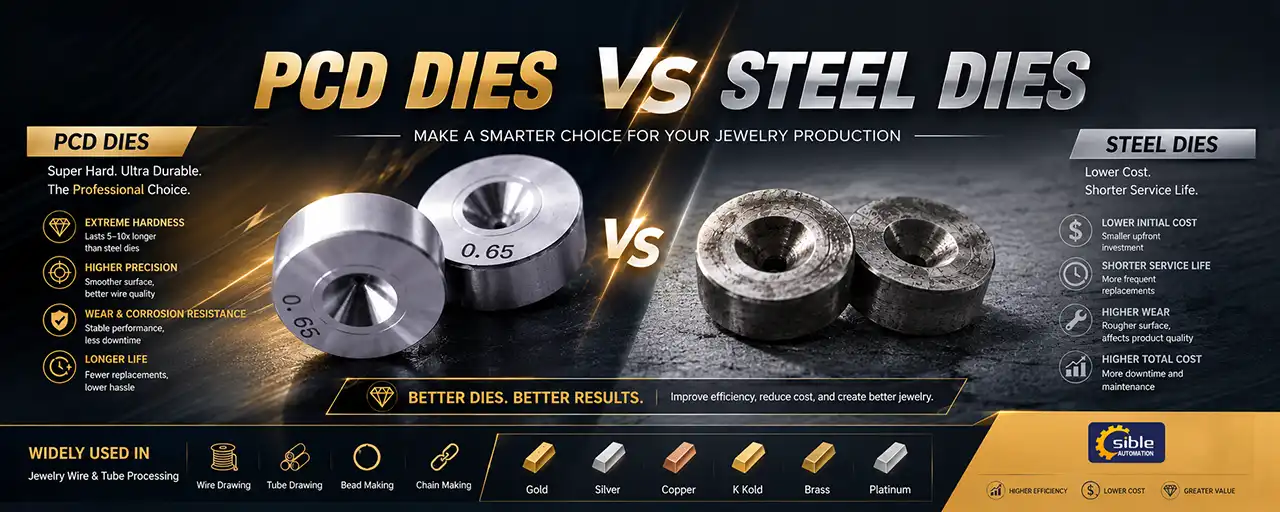
Wire drawing dies are small, unglamorous, and absolutely critical. Every meter of chain, bangle, or finding you produce starts as wire that passed through a die — and the die determines the wire's diameter accuracy, surface quality, and consistency. Choose the wrong die, and the problem shows up everywhere downstream: rejected chain links, poor diamond-cutting results, and wasted precious metal.
For jewelry manufacturers, the practical question usually comes down to two families of dies: PCD (polycrystalline diamond) dies and steel dies — in jewelry wire drawing, "steel die" almost always means a tungsten carbide (cemented carbide) die. This guide explains how they differ, when to use each, and how to choose the right one for your production.
What Are PCD Dies and Steel (Carbide) Dies?
PCD dies use a polycrystalline diamond core — millions of tiny diamond crystals bonded together under high pressure and temperature. The diamond layer sits in a metal (usually tungsten carbide) casing. PCD is one of the hardest materials used in wire drawing, second only to natural and single-crystal diamond in hardness.
Steel/carbide dies use a tungsten carbide core (often called "cemented carbide" or "hard alloy"). Tungsten carbide is a composite of tungsten and carbon, sintered with a metallic binder. It is not as hard as diamond, but it is far tougher — it resists chipping and cracking much better than diamond under shock and impact.
Both die types share the same working principle: wire is pulled through a tapered hole that compresses the metal to a smaller, precise diameter. The difference is in the core material, and that difference drives everything else.
PCD vs Steel (Carbide) Dies: Side-by-Side Comparison
| Factor | PCD Die | Steel (Tungsten Carbide) Die |
|---|---|---|
| Hardness | Extremely hard (diamond-class) | Very hard, but below diamond |
| Wear resistance | Excellent — longest service life between re-polishing | Good, shorter life under continuous use |
| Surface finish on wire | Highest gloss and smoothness | Good, slightly less mirror-like |
| Typical hole range | 0.05mm – 20mm (SIBLE range) | Larger holes, typically ≥1.5mm |
| Toughness / impact resistance | Lower — can chip under shock | Higher — withstands impact and vibration |
| Cost per die | Higher | Lower |
| Best metals | Precious metals: gold, silver, copper, K-gold | Ferrous and non-ferrous wire, larger diameters |
| Maintenance | Re-polishing / re-sizing by specialist | Same, more frequent |
The trade-off is simple: PCD gives you the longest life and the finest finish on precious-metal wire; carbide gives you toughness and economy, especially for larger diameters and heavier reductions.
When to Choose PCD Dies
Choose PCD dies when the wire is fine, the material is precious, or the surface finish matters commercially:
Fine gold, silver and K-gold wire — PCD's smooth, hard bore produces a bright, scratch-free surface that carries straight into finished jewelry.
High-gloss requirements — bangles, chains and findings that will be sold without heavy finishing benefit from the best possible drawn surface.
Long production runs — PCD's wear resistance means fewer die changes and less downtime, which matters when a machine runs thousands of meters per shift.
Consistent precision — PCD dies hold their diameter longer, keeping wire size stable across the whole run.
PCD dies are available from 0.05mm up to about 20mm, which covers virtually all jewelry wire sizes. SIBLE supplies PCD wire drawing dies with sharp, wear-resistant bores, custom hole shapes, and tolerances around 0.001mm.
When to Choose Steel (Tungsten Carbide) Dies
Choose carbide dies when toughness, cost, or diameter size is the deciding factor:
Larger wire diameters (roughly 1.5mm and up) — carbide is the standard choice for bigger cross-sections where diamond dies become uneconomical.
Heavy reductions and roughing passes — the first few reductions from rod to wire put the most stress on a die; carbide's toughness absorbs the shock.
Ferrous or abrasive materials — if you occasionally draw steel, stainless or other hard-alloy wire, carbide handles impact better and costs less to replace.
Cost-sensitive setups — when die budget matters more than maximum die life, carbide is the economical workhorse.
Many workshops run both: carbide dies for the early, heavy reduction stages and PCD dies for the final sizing passes where finish matters most.
Anatomy of a Wire Drawing Die: Why Geometry Matters
Whichever material you choose, the performance of a die depends on its internal geometry. A properly profiled die has six zones:
| Zone | Purpose |
|---|---|
| Bell angle | Funnels lubricant into the die |
| Approach angle | Guides wire into the reduction zone |
| Reduction (compression) angle | Compresses the wire to the target diameter |
| Bearing length (定径带) | Final sizing — controls diameter and surface finish |
| Back relief angle | Supports the bearing, prevents wire drag |
| Exit angle | Lets the drawn wire leave cleanly |
The reduction angle and bearing length are the two zones that matter most for die life and wire quality. A well-designed reduction angle lowers drawing force and friction, so the die wears evenly and the wire deforms stably. The bearing length determines how precisely the final diameter is held and how smooth the surface comes out. A reputable supplier designs these zones around your wire material, entry size, and target diameter — not from a one-size-fits-all mold.
How to Choose: A Practical Checklist
Know your wire range — list every diameter you draw, from entry rod to finest wire. PCD covers 0.05–20mm; very large or very coarse work leans carbide.
Identify the critical finish — which products are sold with the drawn surface visible? Those lines deserve PCD.
Separate roughing and finishing — heavy reductions on large wire = carbide; final sizing of precious wire = PCD.
Calculate run length — long continuous runs favor PCD's wear life; short runs or frequent die changes favor carbide's lower cost.
Ask about geometry customization — confirm the supplier designs reduction angle and bearing length for your specific wire, not just the hole size.
Compare total cost, not unit price — include die life, re-polishing frequency, downtime, and scrap rate. The cheapest die is rarely the cheapest per meter of wire.
Frequently Asked Questions
What is the difference between PCD and carbide wire drawing dies?
PCD (polycrystalline diamond) dies are harder and more wear-resistant, giving longer life and a finer surface finish on precious-metal wire. Carbide (tungsten steel) dies are tougher and more economical, and are typically used for larger diameters and heavier reductions.
Which die is best for gold and silver wire?
PCD dies are the standard choice for fine gold, silver, copper and K-gold wire. Their hardness and smooth bore produce bright, precise, scratch-free wire.
What hole sizes are available?
SIBLE supplies wire drawing dies from 0.05mm to 20mm, in round holes or custom shapes (square, flat square, triangle, hexagon, octagon and more), with tolerances around 0.001mm.
Are custom dies available?
Yes. Dies can be customized for hole size, shape, and internal geometry to match your wire material and drawing machine. Send your wire specifications for a recommendation.
How long does a PCD die last?
Service life depends on wire material, reduction ratio, lubrication and speed. Because PCD is diamond-class in hardness, it typically delivers the longest life between re-polishing of any die type, and dies can be re-polished and re-sized when worn.
Do you supply dies for jewelry wire drawing?
Yes — SIBLE is a factory-direct manufacturer of jewelry machinery and consumables, including PCD, single-crystal diamond, natural diamond and tungsten carbide wire drawing dies. Contact us with your wire sizes for a factory-direct quote.
Related Reading
Wire Drawing Machine for Jewelry: A Complete Guide — how the full drawing process works, machine types, and tension control.
Professional wire drawing dies — SIBLE's die range, specifications, and customization options.




Message Online


